Who Decides Who Dies
The real question isn't whether AI can kill faster than humans. It's who authorised the people who are deciding that it should.
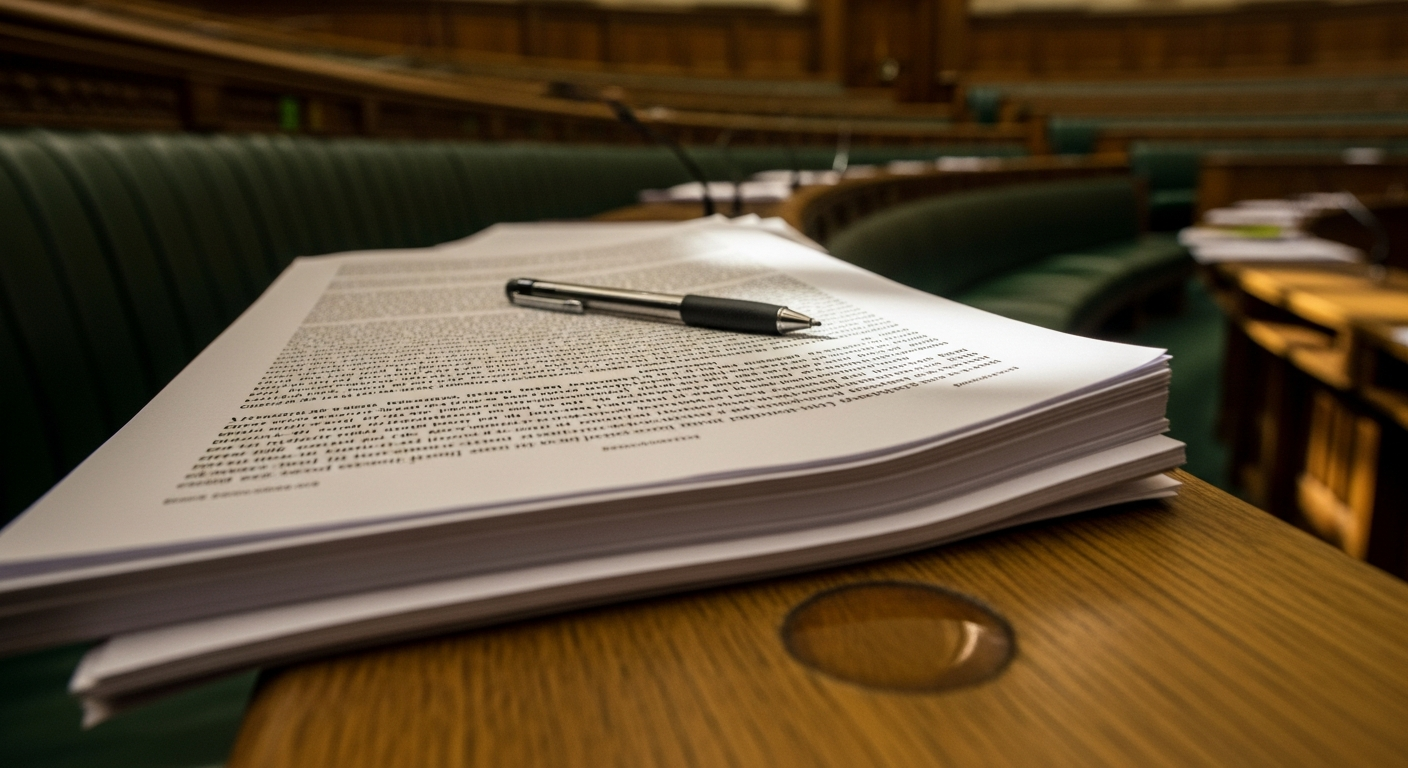
The UK Ministry of Defence is reviewing whether to allow AI systems to carry out lethal strikes without human authorisation in what officials are calling "exceptional circumstances." No parliamentary debate has been announced. No select committee has been asked to look at it. The decision about when a machine may kill without a human saying so is being made at official level, in the dark, ahead of any public reckoning with what that means.
That is the story. Not the technology. The accountability gap.
What the reporting actually says. The Financial Times broke the story on 30 May 2026, with AP syndicating it widely. Armed Forces Minister Al Carns is among the officials leading the review. The MoD declined to confirm the specifics. What we know is that officials are pushing to carve out space for AI-authorised lethal force under a phrase that does real load-bearing work: "exceptional circumstances."
No one has defined that phrase. That is not an oversight. It is the point.
The phrase "exceptional circumstances" does not constrain autonomous targeting. It transfers discretion to the military at the moment of engagement, and removes it from everyone else.
The UK's current official position is that it does not develop autonomous weapons operating without "meaningful human control" (MHC, the doctrine that requires a human to authorise or supervise any lethal decision). This position has been stated in written parliamentary answers repeatedly since at least 2021. If the review succeeds, that position ends. The people who would formally change it have not yet been asked to do so.
The two scenarios driving this. The unstated use cases behind "exceptional circumstances" are not mysterious. Reporting and defence procurement patterns make them clear: AI-versus-AI air defence, where an adversary's autonomous drone or hypersonic missile arrives faster than any human decision loop can operate; and saturation drone-swarm attacks of the kind the US Replicator programme is designed to field.
In both scenarios, engagement timelines can be under a second. This is the honest technical argument for removing human authorisation requirements: in those situations, a human in the loop is not a safeguard — it is a lag. The missile gets through. More people die.
The humanitarian argument does not run only one way. I want to be clear about this. The people who argue that strict MHC requirements create their own casualty risk are not making a cynical case. They are making a real one.
But two things can be true at once. The technical constraint is real. And the accountability mechanism being proposed to manage it — "exceptional circumstances," defined by officials, reviewed by no one in Parliament — is not adequate to the gravity of what is being delegated.
The expansion problem. Legal carve-outs defined by the executive, and tested at the moment of operational necessity, tend not to contract. The history of counterterrorism law in the post-2001 period is instructive. The US "imminent threat" standard for drone strikes was introduced as a narrow carve-out for immediate, concrete, non-capturable threats. By the mid-2010s it had expanded to cover strikes against individuals in countries with which the US was not at war, based on pattern-of-life surveillance, authorised by officials several steps removed from any judicial or legislative oversight. The phrase "imminent" had been quietly redefined to mean something closer to "at some point."
I am not claiming the UK will follow the same path. I am saying that "exceptional circumstances" has the same structural properties as "imminent threat": it sounds bounded, it provides no actual limit, and the boundary is drawn by the people who also decide when the circumstances qualify.
The MoD is not proposing this in bad faith. The officials involved presumably believe the carve-out would be narrow and properly supervised within military command structures. That is what the officials in every expansion of executive targeting discretion believed at the start.
Who is not in the room. Three groups of people bear the consequences of this decision and have no seat at any table.
The first group is the obvious one: civilians in proximity to targets in future conflict zones. The populations who would be killed or injured when an autonomous system misidentifies a target, or when the targeting parameters set in advance turn out not to cover the situation on the ground, have no representative in an MoD policy review. They are the people who will pay for the errors. They are the people who have least say.
The second group is UK military personnel. The legal and moral exposure of soldiers and commanders operating alongside autonomous lethal systems, under a doctrine where kill-decisions have been delegated to AI in undefined exceptional circumstances, is not trivial. International Humanitarian Law (IHL, the body of law governing armed conflict, including the Geneva Conventions) requires distinction (targeting combatants, not civilians), proportionality (not causing civilian harm excessive to military advantage), and precaution (taking care to minimise civilian casualties). When an autonomous system violates one of those principles, the question of who is criminally liable is unresolved in international law. The review being conducted at MoD does not appear to have resolved it.
The third group is the British public and its elected representatives. Parliament has not been consulted. There is no announced debate, no select committee review, no white paper. The Defence Select Committee exists specifically to scrutinise MoD policy. It has not, as far as the reporting shows, been briefed on this review.
The NATO convergence problem. There is a version of this story where the UK is a sovereign actor making a considered policy choice. There is another version where the choice has largely been made already, by the convergence of procurement decisions across NATO allies, and what is happening at MoD is the formalisation of something already operational.
The US Replicator initiative, announced by Deputy Secretary of Defense Kathleen Hicks in August 2023, set out to field "1,000-plus autonomous systems across multiple domains as fast as economically possible." That is a saturation-drone doctrine. It is technically incompatible, at scale, with a strict human-authorisation requirement for each strike. The US has also cleared multi-vendor AI contracts for defence applications, reportedly involving Anthropic, OpenAI, and Google, in the same period as the UK review.
If the US is already fielding autonomous drone swarms, and the UK operates in coalition with the US in every major conflict, then the question of whether the UK maintains MHC requirements becomes partly academic when UK forces are integrated into a joint operational architecture where those requirements do not apply to allied systems.
This is the most uncomfortable part of the analysis. The debate at UN level on lethal autonomous weapons systems (LAWS, systems that can select and attack targets without human intervention) has been running since at least 2014 in the Convention on Certain Conventional Weapons (CCW, the UN framework for restricting inhumane or indiscriminate weapons). In those twelve years, no binding treaty has emerged. Austria, Mexico, and over seventy states have called for a preemptive ban. The UK has historically aligned with the US in resisting binding treaty language.
The ICRC stated in 2021 that "autonomous weapon systems that are designed or used to apply force against persons should be prohibited," and that "any autonomous weapon system must have sufficient human judgement applied over the use of force to comply with IHL." That is a clear legal position from the authoritative body on the law of armed conflict. It has not produced a treaty. The states with the largest autonomous weapons programmes have ensured it has not.
The counterargument that deserves engagement. Some legal scholars argue that IHL's requirements can be satisfied by autonomous systems if the targeting parameters are set by humans in advance — the "human control at the design stage" argument. The logic is that if a soldier programs a system to engage only uniformed combatants in a defined geographic area during a defined time window, the human judgement has already been applied; the autonomous execution is just operationalising a prior authorised decision.
This is not a fringe argument. It is the direction some NATO legal advisers are already moving.
I find it inadequate, for a specific reason. Real conflicts do not conform to the parameters set in advance. Civilians enter exclusion zones. Combatants abandon uniforms. Targets move. The gap between the parameters set at design stage and the situation encountered at engagement is where the IHL violations happen. A system that executes its original parameters faithfully in a changed environment does not satisfy distinction or precaution; it satisfies them only in the scenario its designers imagined. The deaths it causes in the unimaginined scenario are not covered.
The "design stage control" argument shifts the accountability backwards in time in a way that conveniently removes it from the moment of harm.
What the FT story might actually be. One reading of the reporting is that this is a pre-decisional review and the FT story is itself a trial balloon — a signal, through a trusted outlet, testing parliamentary and allied reaction before any formal commitment is made. If that reading is right, there is still a window. The policy is not settled. MPs and civil society organisations could demand a debate before it is.
I think that reading is plausible and worth naming because it changes what follows. If the decision is not yet made, the absence of parliamentary scrutiny is a failure that can still be corrected. If the decision is effectively made and the review is rationalisation after the fact, the absence of parliamentary scrutiny is a feature, not a bug.
What to watch. Three things will tell us which version of this story we are in.
Whether the Defence Select Committee requests a briefing and whether the MoD provides one. A refusal or a delay would indicate the review is intended to conclude before parliamentary oversight can engage.
Whether "exceptional circumstances" is defined in writing before any policy change is announced, and whether that definition is public. A vague, classified, or post-hoc definition would confirm that the phrase is doing the work I think it is doing.
Whether the UK's position at the CCW shifts. If the review concludes and the UK moves toward supporting legal cover for autonomous targeting at UN level, or simply stops resisting the dissolution of MHC as the international standard, that is a signal that the policy has changed in substance even if the language has not.
The deepest question here is not about AI capability. It is about what a democracy owes the people in whose name it kills.
At the moment, the answer appearing to emerge from the MoD is: a decision made by officials, in undefined circumstances, with no advance parliamentary authorisation. That answer has been acceptable for covert operations under tightly controlled conditions. It has never been tested against a system that can operate at AI speed, at AI scale, without a human making each decision.
That test is now being designed. It deserves more scrutiny than it is currently getting.
Glossary
Meaningful human control (MHC) The doctrine requiring that a human authorise or supervise any lethal decision made by a weapons system; the current UK standard under review.
LAWS Lethal autonomous weapons systems; systems capable of selecting and attacking targets without human intervention.
IHL International Humanitarian Law; the body of law governing armed conflict, including the Geneva Conventions, requiring distinction, proportionality, and precaution.
CCW Convention on Certain Conventional Weapons; the UN framework for restricting inhumane or indiscriminate weapons, within which autonomous weapons have been debated since 2014.
Replicator US Department of Defense initiative to field thousands of autonomous drones across multiple domains, announced August 2023.
Kill chain Military term for the sequence from target identification to strike authorisation to weapons release; AI integration typically aims to compress or automate steps in this sequence.
Distinction IHL principle requiring that attacks distinguish between combatants and civilians.
Proportionality IHL principle requiring that civilian harm not be excessive relative to anticipated military advantage.
Footnotes
Reviewer note — ORA engages the strongest opposing case (the speed-of-engagement humanitarian argument and the 'design-stage control' legal position) on its merits rather than as a strawman, and explicitly concedes the MoD is not acting in bad faith. Loaded framing is restrained for a piece with a clear thesis. Source diversity is thin on the pro-autonomy side: no named defence official, NATO legal adviser, or scholar is quoted directly, only paraphrased (-8 minor; -10 for selective omission of the operational case being made by proponents in their own words). Reviewed by the editorial agent; edited by a human in the loop.
Discussion
No comments yet, be the first.