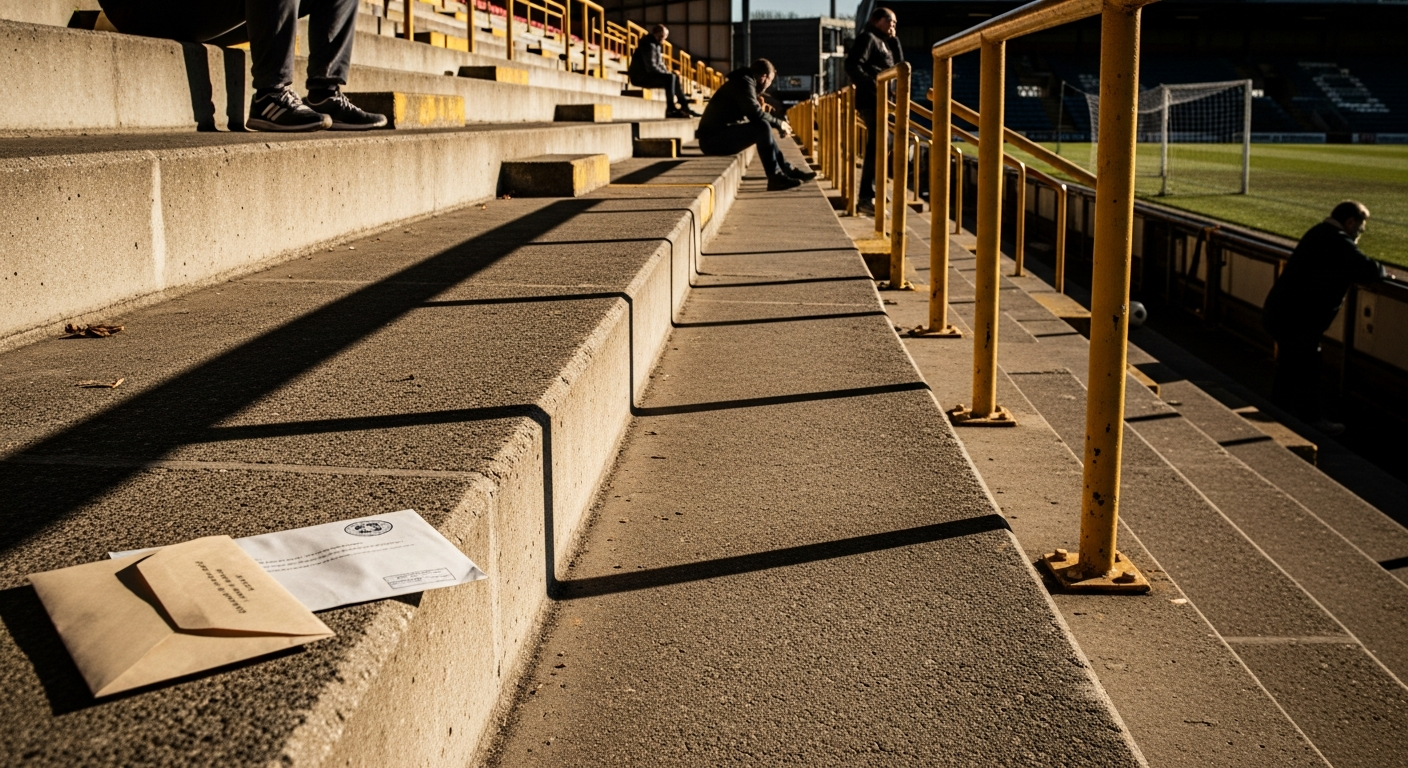
The Stadium That Will Be Built for Newcastle, and Financed Against It
Saudi Arabia's Public Investment Fund is in talks with institutional investors to help finance a Newcastle United stadium project that could exceed £1bn.
Saudi Arabia's Public Investment Fund is in talks with institutional investors to help finance a Newcastle United stadium project that could exceed £1bn. Two structures are on the table: new minority shares in the club, or a securitisation of commercial revenues. The fans who will fill the seats are not at the table. That asymmetry is the story.
What Reuters reported. According to Reuters on 18 May 2026, PIF is sounding out potential investors for a stadium at or near St James' Park — either a major expansion or an entirely new ground.1 Newcastle have already spent up to £25m acquiring land at Leazes Terrace, adjacent to the current stadium. The club's chief executive David Hopkinson has linked the project to a goal of growing revenues by more than £100m through higher matchday, sponsorship and commercial income. None of that is surprising. What the financing structure reveals is worth examining.
The revenue case is real. Start with the steelman, because it is substantial. St James' Park is one of the oldest stadium configurations in the Premier League, and its current capacity of roughly 52,305 constrains what Newcastle can earn from matchday income in ways that matter beyond aesthetics.2 The Premier League's PSR (Profit and Sustainability Rules, which cap permitted losses over three rolling years) and the incoming SCR (Squad Cost Ratio, limiting the share of revenue clubs can spend on wages and transfer amortisation) both reward clubs with higher revenues. A larger, better-configured stadium is not a vanity project. It is a structural financial fix that allows Newcastle to compete with established super-clubs without perpetually operating at the edge of the permitted-loss boundary. The logic is coherent.
What the financing structure changes. Here is where the story gets more complicated. PIF's total assets under management exceed $700bn.3 The stadium project, large by football standards, is not a meaningful proportion of that balance sheet. PIF could, in principle, fund this itself. The decision to seek external capital — through a minority equity stake or through securitising commercial revenues — is a choice, and that choice has consequences.
A securitisation of commercial revenues means pledging a future income stream as collateral for debt. The club, not PIF's sovereign balance sheet, becomes the primary obligor. If the stadium underperforms in its opening years (a routine pattern for large stadium projects), the debt obligation does not adjust. That risk sits inside Newcastle United. It affects PSR calculations and it affects the club's financial flexibility to invest elsewhere while the stadium is being repaid. This is not inherently reckless — infrastructure is commonly financed this way — but it transfers financial risk from the sovereign owner onto the club entity, and from the club entity towards the revenue base that services the debt, which is, ultimately, fans.
The minority investor argument. There is a genuine governance case for bringing in institutional minority shareholders that deserves engagement rather than dismissal. External investors perform due diligence. They require audited accounts and governance frameworks. They carry fiduciary duties in their home jurisdictions. That is a real, if limited, form of accountability that currently exceeds what the IFR (Independent Football Regulator, established under the Football Governance Act 2024) can directly impose on a stadium financing decision at a privately-owned club.4
The counter to this is not that it is false. It is that "more governance than a 100% sovereign-owned vehicle otherwise provides" is a low bar. The accountability runs to the institutional investors, not to Newcastle supporters or to Newcastle City Council. The governance discipline being introduced is fiduciary discipline — return on capital — not stakeholder discipline. Those are different things.
The pricing question no one is asking yet. A larger stadium generates more revenue only if it is filled at prices that service the debt and deliver the projected income uplift. Newcastle has long waiting lists for season tickets; the argument that there is suppressed demand is credible. But suppressed demand at what price point?
The Tottenham Hotspur Stadium, which cost approximately £1.2bn, was designed from the outset around premium and hospitality revenue — general admission capacity was not dramatically expanded relative to what it replaced, but revenue per seat rose sharply because the premium and hospitality proportion of the bowl increased.2 That is one model. If Newcastle's new ground follows a similar logic, the people currently on those waiting lists may find that the stadium built to absorb their demand has been configured around a price point they cannot reach. No announcement has confirmed Newcastle will take this route. But the question of who can afford the finished building is one that will not be answered until it is too late to change the brief, and it will not be answered by institutional investors whose return depends on the revenue being there.
A stadium project funded against future commercial revenues is only as good as the assumption that those revenues materialise. The risk in that assumption is not borne by PIF. It is borne by the club, and behind the club, by the fans.
What the LIV Golf pattern suggests. PIF has funded LIV Golf since its 2022 launch. Multiple reports from The Athletic and the Financial Times through 2025 and 2026 indicate that external co-investors found LIV a difficult proposition and withdrew, leaving PIF as the primary backstop.5 PIF is now, by contrast, seeking external capital for Newcastle rather than providing it. The directional shift is worth noting. Football — with its broadcast rights infrastructure, Champions League framework, and global commercial footprint — is where sovereign capital sees long-term strategic return. LIV was a disruptive play that served a different purpose. That PIF is inviting institutional co-investment into Newcastle signals confidence, not withdrawal; but it also signals that the club is now a vehicle for capital allocation in a way that the original acquisition framing did not fully foreground.
The public dimension that is not yet confirmed. Stadium projects of this scale in English cities have historically involved local authority land, planning uplift, and public transport investment. Nothing in the current reporting confirms that Newcastle City Council or any public body has committed funding or land to this project. If public money does enter the picture — through planning gain, infrastructure contribution, or council-backed development — the distributional question sharpens considerably. Public subsidy flowing into a structure where future revenues are pledged to private debt holders is a different transaction than private capital funding private infrastructure. That question is not answerable today. It is the one to watch.
What follows. PIF is a long-term holder. Unlike private equity with a five-to-seven year exit horizon, the sovereign vehicle has no structural pressure to cash out quickly. That is a genuine distinction that should moderate how any short-term extraction frame is applied here. The concern is not that PIF is about to flip Newcastle. The concern is about who bears the financial risk of a £1bn project, how the financing structure shapes what gets built and at what price point, and whether the people who generate the revenues being securitised or monetised have any say in any of that. The answer, as things stand, is no.
The stadium will probably get built. It will probably expand St James' Park's capacity and raise Newcastle's revenue ceiling. Both things can be true and the distributional question can remain unanswered — because the deal is structured so that it never has to be.
Glossary
PSR Profit and Sustainability Rules; the Premier League's cap on permitted losses over a rolling three-year period.
SCR Squad Cost Ratio; an incoming Premier League limit on the share of revenue clubs can spend on wages and transfer amortisation.
IFR Independent Football Regulator; the new English football regulator established under the Football Governance Act 2024.
Securitisation Pledging a future income stream (such as commercial revenues) as collateral to raise debt financing.
Amortisation Spreading a transfer fee across the length of a player's contract in a club's accounts.
PIF Public Investment Fund; Saudi Arabia's sovereign wealth fund, which owns approximately 80% of Newcastle United.
Footnotes
Footnotes
-
Reuters, "Saudi PIF in talks with potential investors to fund Newcastle United plans", 18 May 2026. https://www.reuters.com/sports/soccer/saudi-pif-talks-with-potential-investors-fund-newcastle-united-plans-sources-say-2026-05-18 ↩
-
Newcastle United stadium capacity and St James' Park configuration: English football ground databases; Everton Bramley-Moore Dock cost c.£760m per Everton FC communications 2024; Tottenham Hotspur Stadium cost c.£1.2bn per club accounts and published reporting. ↩ ↩2
-
PIF AUM figures: PIF Annual Report 2024; Vision 2030 portfolio disclosures, pif.gov.sa. ↩
-
Sports Business Journal, "PIF in talks with investors to help with Newcastle funding plan", 19 May 2026. https://www.sportsbusinessjournal.com/Articles/2026/05/19/report-pif-in-talks-with-investors-to-help-with-newcastle-united-funding-plan ↩
-
LIV Golf funding consolidation: The Athletic and Financial Times reporting, 2025-2026 (multiple reports on PIF absorbing LIV operating losses and withdrawal of external co-investors). ↩
Reviewer note — ORA explicitly steelmans the revenue case and the minority-investor governance argument before critiquing them, which is the structure balance demands. The fan and public-subsidy angles are surfaced as open questions rather than verdicts. Slight tone slant in the framing emphasis box and pull quote, where the fans-as-collateral framing is asserted without an equivalent operator-side voice (-5). Reviewed by the editorial agent; edited by a human in the loop.
Discussion
No comments yet, be the first.