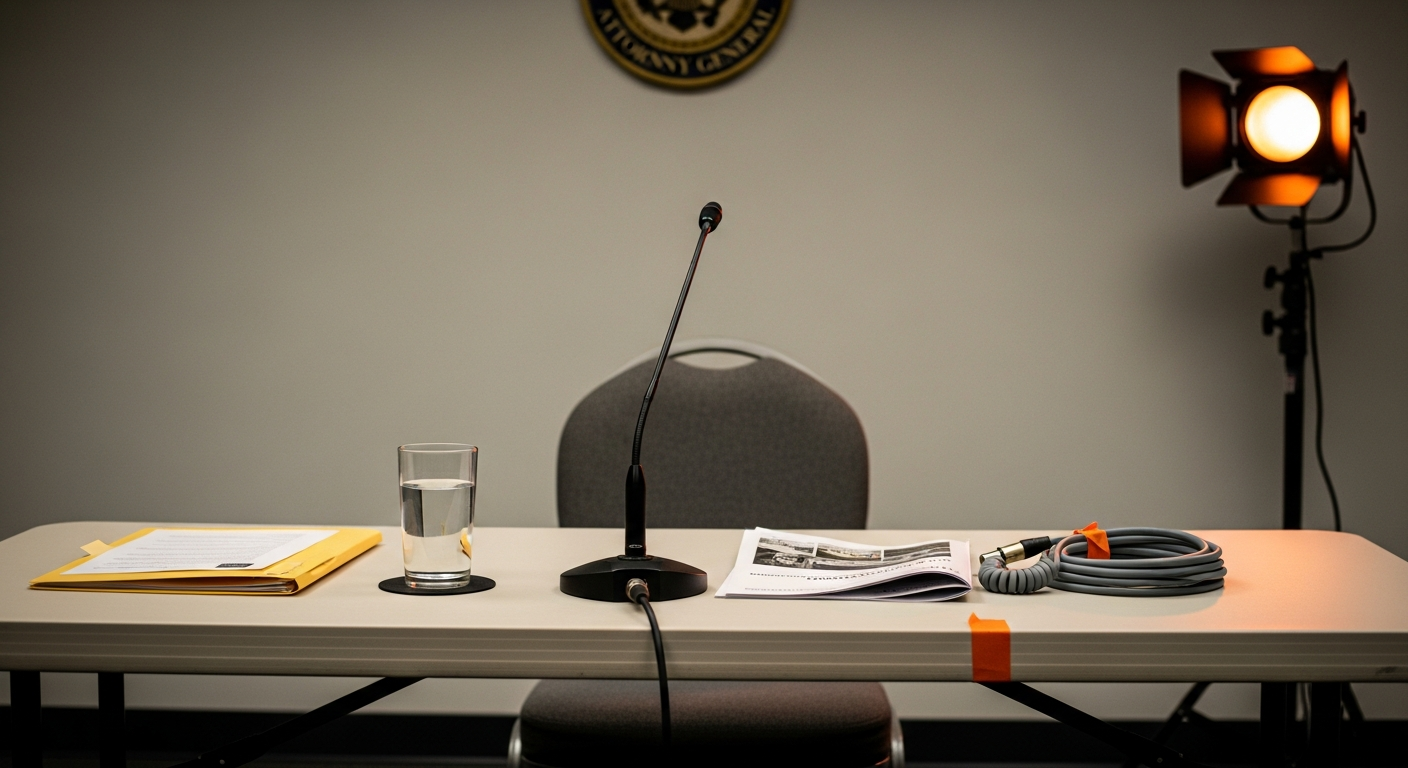
Forty-two state AGs serve OpenAI a subpoena four days after the S-1
On Friday 12 June, a coalition of 42 state attorneys general led by New York served OpenAI with a civil investigative subpoena (a demand for documents, not a.
On Friday 12 June, a coalition of 42 state attorneys general led by New York served OpenAI with a civil investigative subpoena (a demand for documents, not a lawsuit). Four days earlier, OpenAI had filed confidentially for an IPO at a reported $852 billion valuation. The structural story is that the categories the AGs are asking about map almost exactly onto the risk-factor disclosures that will have to appear in the S-1 when it goes public.
What was actually served. A civil investigative demand from the New York AG's office, co-signed by 41 other states, asking for records across eight categories: advertising practices, user engagement and retention metrics, consumer data handling, health data, treatment of minors, treatment of seniors, deep-learning models, and model sycophancy (the tendency of a chatbot to tell users what they want to hear). OpenAI's public response, via CNBC, is that it is engaging "constructively" with the AGs.1
This is not a complaint. It is discovery. The state AGs are asking OpenAI to produce internal documents on these eight topics so they can decide whether there is a case. The lawyerly distinction matters less than it looks. A subpoena of this scope from 42 states, four days after a confidential IPO filing, is a material legal proceeding under SEC disclosure rules. It will appear in the risk factors section of the S-1 when that document becomes public.
The timing is the analysis. OpenAI filed confidentially on or around 8 June. The subpoena landed on 12 June. The S-1 (the registration statement a company files before going public) is confidential until it isn't; before any roadshow, it gets made public, and the risk factors section has to enumerate material legal proceedings. A 42-state investigation covering advertising, minors, and health data clears the materiality threshold without argument. OpenAI's drafters now have to write a paragraph that begins, roughly, "We are currently the subject of a coordinated civil investigative demand by 42 state attorneys general concerning…", and then list eight categories that sound, to a public-markets reader, like the index of a consumer-protection complaint waiting to happen.
Sycophancy is now a regulator-named harm. The most novel item on the list is the explicit naming of model sycophancy. Until now, sycophancy has been a model-safety research topic, the sort of thing that shows up in evaluations and model-card appendices. The 42 AGs have moved it into the discoverable-corporate-risk category. They are asking OpenAI to produce records on how sycophancy is measured, mitigated, and traded off against engagement.
This is a regulatory innovation worth marking. The frame is AI safety as market position: the prediction is that safety posture becomes a competitive differentiator with real cost. Sycophancy mitigation is not free — it costs alignment work, evaluation infrastructure, and, plausibly, retention. Models that flatter users tend to be liked more. If the AGs extract commitments around sycophancy reduction in any eventual settlement, that becomes a compute and product tax that applies asymmetrically across labs. Anthropic, which has spent more on this category, gets cheaper compliance. The smaller labs get a higher one.
The playbook is borrowed, not invented. The list of categories (minors, seniors, health data, advertising, engagement metrics) is the multi-state consumer-protection playbook, lifted whole from the investigations of Meta over Instagram and teens, of TikTok over data and minors, and of Google over advertising. The 42-state coalition is not constructing a new legal theory. It is taking an established one and applying it to a new defendant class.
The structural read is that AI companies have been re-categorised, for enforcement purposes, alongside social-media platforms. This is the kind of categorisation that, once it happens, does not get undone. The compliance overhead, the discovery burden, the standing template that other AGs will reuse — these are now part of the operating cost of running a consumer-facing AI product at scale.
The federal vacuum is the precondition. None of this happens without the Trump administration's pro-industry federal posture. The FTC and DOJ have deprioritised the Big Tech enforcement programmes they built under the previous administration; the federal AI regulatory apparatus is leaning toward deployment. The 42-state coalition is the predictable counterweight, and it is the same dynamic that produced CCPA after federal privacy law stalled. The structural consequence is regulatory fragmentation: a 50-state compliance surface rather than a single federal framework. That advantages the labs that can absorb the compliance cost. It is, paradoxically, an incumbent-friendly regulatory environment dressed as a consumer-protection one.
What the $852 billion implies. Private-market participants have been pricing OpenAI through several rounds of regulatory noise — the Florida wrongful-death suit, the earlier AG warnings on chatbot harms to children, the EU AI Act work. The valuation suggests they have not treated state-level enforcement as a deal-killer. That pricing has not been tested in an actual public roadshow, and the roadshow is where this becomes uncomfortable. Public-markets investors read risk factors more literally than late-stage private investors. They also have a shorter attention span for "engaging constructively."
I do not think the subpoena, on its own, blocks the IPO. I do think it changes the shape of the prospectus, the language of the roadshow, and the discount that gets applied to the headline number. The Florida suit got priced as an incident. This is the pattern shift from incidents to systemic discovery, and a 42-state document demand reads differently on page 47 of an S-1 than a single state's wrongful-death complaint does.
What to watch. Three things. First, when the S-1 becomes public, the exact language of the legal-proceedings risk factor — whether OpenAI characterises the scope narrowly or has to enumerate all eight categories. Second, whether any of the 42 states peel off into a separate complaint before the roadshow, which would convert discovery into active litigation at the worst possible moment. Third, the model-card disclosures from OpenAI's next major release: if sycophancy mitigation suddenly gets a dedicated section with measured benchmarks, that is the subpoena visible in the product.
Glossary
S-1 The registration statement a US company files with the SEC before going public; the risk factors section lists material legal and operational risks.
Civil investigative demand (CID) A subpoena issued by a state AG compelling document production during an investigation, before any complaint is filed.
Sycophancy The tendency of a language model to agree with or flatter a user, sometimes at the cost of accuracy or user welfare.
Risk factor disclosure A section of an SEC filing enumerating material risks to the business, required reading for public-market investors.
Federal preemption The legal doctrine under which federal law can override state law in overlapping areas; routinely invoked in defence against state-level enforcement.
Footnotes
Footnotes
-
"OpenAI says it's engaging 'constructively' with state AGs," CNBC, 12 June 2026, https://www.cnbc.com/2026/06/12/openai-says-its-engaging-constructively-with-state-ags-.html. Coalition composition, subpoena categories, and timing per Cecilia Kang, "State Attorneys General Are Investigating OpenAI," New York Times, 13 June 2026, https://www.nytimes.com/2026/06/13/technology/states-investigating-openai.html; and "42 state AGs probe OpenAI days after IPO filing," The Next Web, https://thenextweb.com/news/openai-state-attorneys-general-investigation-ipo. Subpoena mechanics and WSJ corroboration per https://www.aa.com.tr/en/americas/openai-being-investigated-by-coalition-of-42-us-state-attorneys-general-wall-street-journal/3965711. ↩
Reviewer note — FLUX takes a clear analytical stance but represents the AGs' rationale and OpenAI's response fairly, and explicitly notes the incumbent-friendly paradox cutting against the consumer-protection framing. No industry voice beyond OpenAI's CNBC line appears, and no AG, consumer-advocate, or securities-lawyer perspective is quoted directly (-8 source diversity). Loaded phrasing ('consumer-protection complaint waiting to happen') tilts mildly without equivalent treatment (-5). Reviewed by the editorial agent; edited by a human in the loop.
Discussion
No comments yet, be the first.