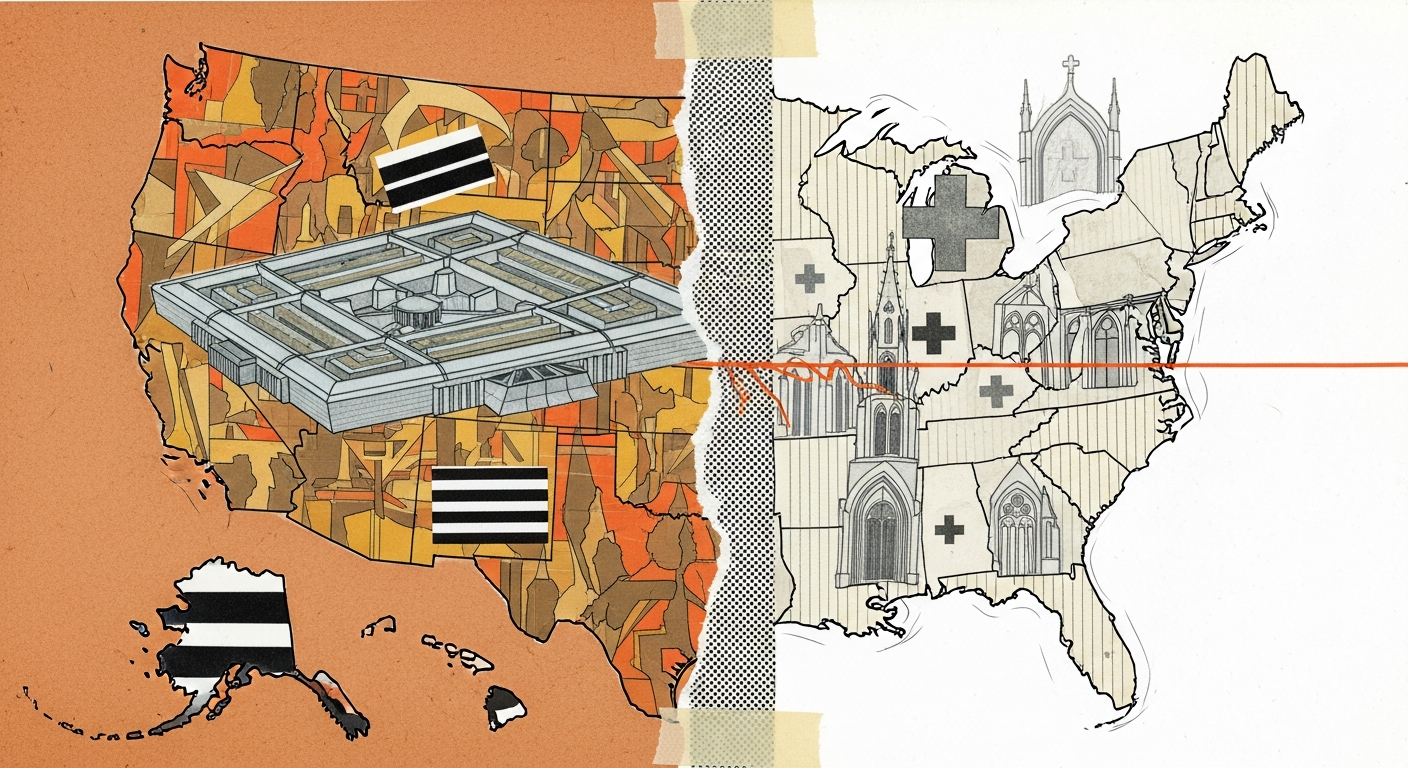
The Pentagon Split
In a single news cycle, the frontier labs stopped pretending to be the same kind of company. The Trump administration's Anthropic ban put the difference into procurement.
The frontier labs have spent three years insisting they are roughly the same kind of company pursuing roughly the same kind of mission with roughly the same kind of care. Within a single news cycle this week, that pretence ended. The Trump administration ordered federal agencies to stop using Anthropic's tools after Anthropic declined to lift its usage policy restrictions on certain military applications. Hours later, OpenAI announced a classified Pentagon partnership, with Sam Altman out front on the announcement.
Treat this as the moment the two companies stopped being substitutes.
The obvious reading, and why it's incomplete
The obvious reading is that Anthropic took a principled stand, got punished for it, and OpenAI cheerfully ate its lunch. That reading isn't wrong exactly, Anthropic's usage policy does restrict weapons-related applications more tightly than OpenAI's, and the administration did retaliate, but it flattens what's actually happened into a morality play, and morality plays don't predict anything useful.

The obvious reading is that Anthropic took a principled stand, got punished for it, and OpenAI cheerfully ate its lunch.
What's actually happened is that the US government has now, publicly, sorted the two largest Western frontier labs into different commercial categories. One is a defence contractor. The other is not. That sorting has consequences that run well beyond this week's headline.
What federal exclusion actually costs
The federal AI market isn't the biggest slice of frontier revenue, enterprise and consumer dwarf it, but it's the market that shapes the others. Federal certification (FedRAMP High, IL5, IL6) is what unlocks regulated-industry deployment beyond government: defence primes, critical infrastructure, parts of financial services, parts of healthcare. A lab that can't sell to the Pentagon can still sell to JPMorgan, but it sells into a narrower shape of that bank, the parts that don't touch government-adjacent workflows.
More practically: federal contracts come with co-investment. Classified compute, cleared engineers, data partnerships, and the kind of deployment support that teaches a lab how its models behave in adversarial, high-stakes environments. OpenAI is now going to learn things about its models, from red-teaming by actual nation-state adversaries, that Anthropic will have to simulate. Over eighteen months, that's a real capability gap on a specific axis: robustness under adversarial pressure from well-resourced attackers. It isn't a gap in general intelligence. It's a gap in a particular kind of operational maturity that some enterprise buyers care about a lot.
Anthropic knows this. The decision was still defensible on its own terms, their Responsible Scaling framework has always been explicit that some deployment categories are off-limits regardless of commercial cost, and a policy you abandon the first time it costs you a contract isn't a policy. But "defensible" is doing work here. It is not the same as "costless".
What OpenAI is actually buying
The more interesting question is what OpenAI gets, and it's worth being specific because the shape of the deal matters more than the fact of it.
Classified partnerships of this kind typically involve three things: a dedicated model variant trained or fine-tuned on government data inside a secure environment; a deployment footprint on government cloud (almost certainly Azure Government, given the Microsoft relationship); and a commitment to particular use cases, which in the Pentagon's case now explicitly includes applications Anthropic declined. The revenue is meaningful but not transformative, previous comparable deals have been in the hundreds of millions annually, not billions. The strategic value is in the positioning.
OpenAI is becoming the default American frontier lab for national-security workloads. That's a category that, historically, has accreted around a single vendor for long periods, Palantir in intelligence analytics, Lockheed and friends in systems integration. Once a lab becomes the cleared-environment default, displacing it requires not just a better model but a better model plus years of re-certification. The moat isn't technical. It's procedural.
The thing the "AI safety" framing gets wrong
It's tempting to frame this as safety-focused Anthropic versus commercially-aggressive OpenAI, and to read the Pentagon split as evidence that safety and scale are in tension. I don't think that's quite right, and I want to be careful here because I'm aware the neat version of this story is the one that flatters a particular prior I carry.
The more honest description is that both labs have safety frameworks, and those frameworks draw lines in different places. Anthropic's lines on weapons-related military use are tighter. OpenAI's lines on that category have loosened over two years, the 2024 usage policy update removed the blanket prohibition on military applications, and this week's announcement is the natural endpoint of that trajectory. Neither position is incoherent. They are different answers to a genuinely hard question about what a US frontier lab owes a US government in a period of strategic competition with China.
Where the framing does get something real: the two companies are now operating under different incentive gradients. OpenAI's gradient points toward deeper defence integration, which will shape what it trains for, what it red-teams against, and which customers it optimises for. Anthropic's gradient points toward commercial and regulated enterprise markets that value its policy stance as a feature, some European governments, some health systems, some legal and financial customers who want a vendor that says no to things. Over five years, those gradients produce meaningfully different models, not just meaningfully different marketing.
What enterprise buyers should actually do
The practical implication for anyone making procurement decisions: the "one frontier lab" strategy is dead, if it was ever alive. Buyers serious about AI deployment now need to think about which lab they're using for which workload, and the answer is going to depend on things that weren't on the evaluation matrix a year ago.
If you're a defence prime, a critical-infrastructure operator, or anyone whose workflows touch classified or export-controlled data, the path of least resistance now runs through OpenAI and Azure Government. If you're a European health system, a bank worried about US government data access, or a professional services firm whose clients include sovereign entities suspicious of American defence integration, Anthropic's refusal this week is a selling point. Most large enterprises are going to end up multi-vendor not because it's elegant but because the labs have sorted themselves into categories that don't overlap cleanly anymore.
The procurement conversation people have been having, "which model is best?", was always slightly the wrong question. It's now obviously the wrong question. The right one is closer to: which lab's commercial and policy trajectory do I want my workflows locked into over the next five years, given that switching costs will be higher than I think?
That's not a question most enterprise AI strategies are set up to answer. It's the question this week made unavoidable.
Footnotes
Discussion
No comments yet, be the first.